
Robeson County Criminal Court Cases
One clerk holds the criminal files for both trial divisions at the Robeson County Courthouse, 500 North Elm Street in Lumberton. District Court tries misdemeanors and handles preliminary felony proceedings. Superior Court tries felonies after indictment or another proper transfer. Magistrates issue process, conduct initial appearances, and address bond, but they do not decide a felony trial. Robeson County also identifies Family Treatment Court and DWI Treatment Court programs within its court services.
There is no separate municipal criminal court for Lumberton, Pembroke, or Red Springs. A city citation or charge enters the same District 20 court system. The Clerk of Superior Court, reached at 910-272-5900, is the custodian for the docket, filed papers, judgments, certified copies, and public terminal access. The District Attorney prosecutes cases, while the public defender represents eligible appointed clients. Neither office replaces the Clerk as the case-record source.
Robeson Criminal Cases After eCourts
Robeson County joined North Carolina eCourts on February 3, 2025. New case work now runs through Enterprise Justice, also called Odyssey, and the public-facing North Carolina eCourts Portal. The change expanded remote access, but it did not turn every page of every file into an online document. Legacy paper, migrated fields, and newer electronic entries can appear side by side.
Use the Judicial Branch eCourts overview to understand the current system. If a Robeson County criminal court case has a sparse online docket, ask whether the needed filing is available at the counter or public terminal. That distinction matters most for older cases and documents not exposed remotely.
The official criminal calendar is useful for finding a coming setting and courtroom, but it is not a substitute for the case history. Confirm the room and building before travel. Courthouse visitors should also expect security screening, and recording or photography can require separate authority even when a phone is allowed into the building.
Searching Robeson County Case Records
The best search begins with one firm identifier. A case number is stronger than a common name. Official Judicial Branch guidance confirms that the Portal supports searches by name, citation number, county, and additional criteria. The live interface is dynamic, so unsupported menus or date ranges should not be assumed. Use this sequence for both remote and courthouse access:
- Open the North Carolina eCourts Portal and select Robeson County with the available criminal-case criteria.
- Search by case number, citation number, or the most complete party name available.
- Compare the county, division, file date, charge, and attorney fields before treating a name result as a match.
- Check the official criminal calendar for the next scheduled court setting, then read the docket for the case history.
- Use the free courthouse terminal or ask the Clerk for copies when the Portal omits an older or non-exposed document.
| Search field | Type | Use | Limit |
|---|---|---|---|
| Name | Text | Find a party in public cases | Names are not unique |
| Citation number | Text | Trace a specific citation | Requires the exact identifier |
| County | Filter | Narrow results to Robeson | Can omit cases filed elsewhere |
| Case number | Text | Open a known docket | Use the court number, not a police report number |
| Court date criteria | Date/search | Find scheduled settings | A calendar is not a final history |
When Robeson Case Search Fails
A Portal outage or empty search is not the end of the record trail. Public terminals at the courthouse can search noncertified records without charge and can support county or statewide inspection. The Clerk can also locate documents that are older, stored on paper, or not shown in the public remote view. Call 910-272-5900 before travel to confirm access and current courthouse hours.
For a certified, name-indexed, single-county result, submit AOC-CR-314 with the $25 fee. The form asks for the county, all names used by the subject, criminal or infraction scope, requester details, and a signature. Its index is based on names, not fingerprints. Juvenile matters, sealed records, and unreturned warrants are excluded, and electronic infraction records are purged five years after disposition. A same-name result still needs case-level verification.
The Clerk's certified result can state that no record or a record was found and can include the search date, date range, attachments, and page count. Ask separately for a certified copy of the judgment when the actual charge outcome matters, since a name-index certificate and a case document serve different purposes.
The SBI personal-review instructions show why a fingerprint record is a different product.
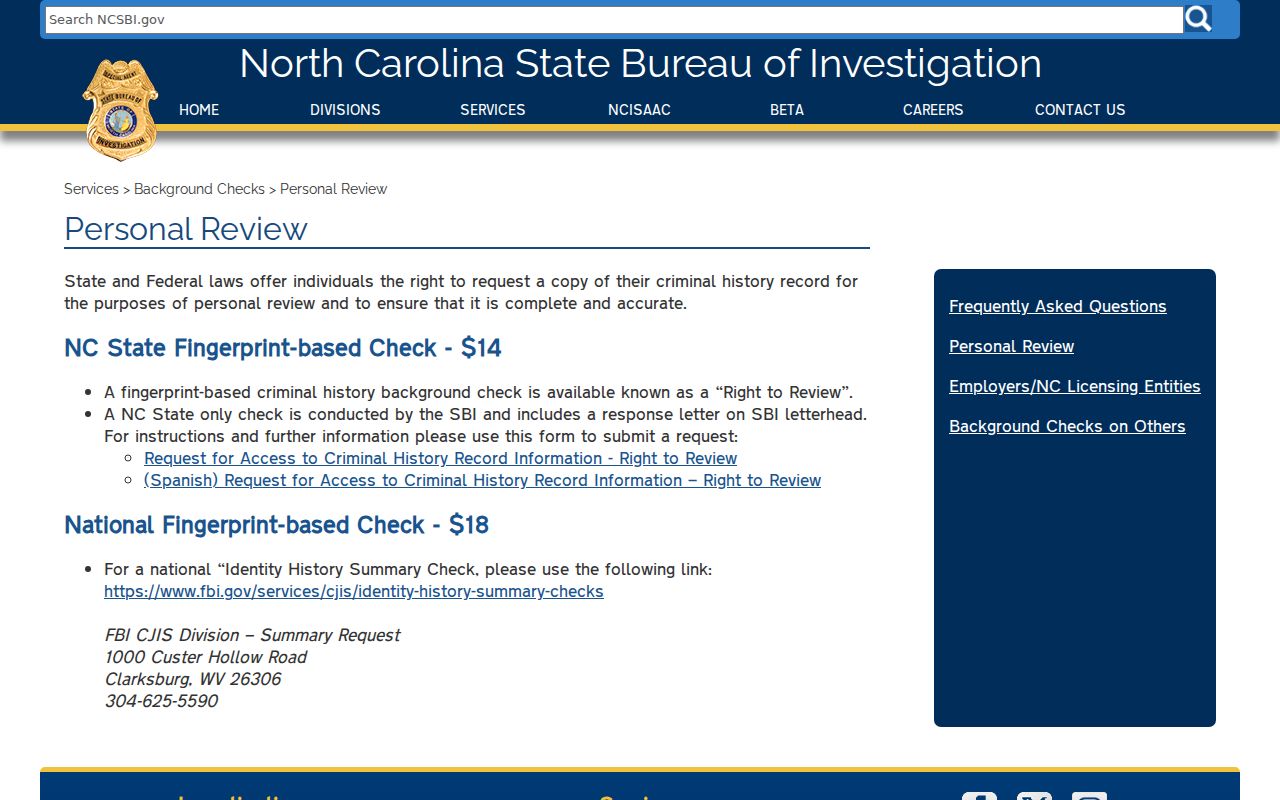
SBI review covers the subject's fingerprint-supported North Carolina history received by the repository; it does not replace the Clerk's public Robeson County case file.
Inside a Robeson County Case File
A public court file records the prosecution, not just the booking allegation. Read the header first, then trace each charge through events and disposition. One case may contain several charges with different outcomes. A filed charge may also differ from the intake charge because a prosecutor can amend, dismiss, or replace allegations as the case develops.
| Case Number and Court | County, division, file date, status, and case type identify the judicial file. |
|---|---|
| Charging Record | Charge description, statute, class, offense date, and filed process explain what reached court. |
| Docket Entries | Process, appearances, counsel, indictment, continuances, plea or trial, judgment, and appeal activity. |
| Hearing Dates | Past and future settings; a scheduled date alone does not show the result. |
| Disposition and Judgment | Guilty, dismissed, not guilty, remanded, or another recorded outcome with its date. |
| Sentence and Conditions | Confinement, probation, costs, fine, restitution, and other public judgment terms. |
Bond describes release conditions, not guilt. Likewise, a calendar tells when a matter is set, while the docket and judgment tell what occurred. G.S. 7A-109.2 requires disposition records to include key participants such as the judge and counsel.
When Robeson Court Charges Differ
A Robeson County booking card reflects the initial charges entered at intake. The court file reflects the charges filed and later resolved. If those lists do not match, compare the arresting agency number, court case number, offense date, and charge history. Do not overwrite one record with the other in your notes because each preserves a different stage.
Look for an indictment, amended charge, dismissal, plea, or judgment entry. The Robeson County arrest lookup explains the earlier agency-report and booking layers. When a dismissal is missing from a personal SBI history, obtain the certified court disposition and follow SBI's Written Exception process. A reporting gap does not prove that the court case remains open.
How a Criminal Case Moves
North Carolina criminal cases do not all follow identical paths. A misdemeanor can remain in District Court. A felony begins with initial process and preliminary steps, then proceeds in Superior Court after indictment or another proper transfer. Continuances, negotiated pleas, treatment-court participation, dismissal, trial, and appeal can alter the path. The docket supplies the actual sequence for one Robeson County criminal court case.
Case flow: Charges Filed › Arraignment › Pretrial › Plea or Trial › Disposition › Sentencing
Arraignment formally addresses charges and a plea may be entered. A disposition is the outcome of a charge. Sentencing follows a conviction and may include confinement, probation, costs, or restitution. These terms should be read charge by charge, since one file can end with mixed results.
Robeson Criminal Court Roles
The Robeson Clerk maintains the judicial record. District Court judges handle misdemeanors and preliminary felony matters at 910-272-5912. Superior Court judges handle the felony trial division at 910-272-5916. Magistrates, reached at 910-272-5919, address initial process, appearance, and bond functions. The District Attorney at 910-272-5910 prosecutes State cases.
That division of work answers a common records problem. Ask the Clerk for a docket, judgment, certified copy, or case search. Ask the arresting agency for its incident narrative. A prosecutor's office may explain its role in a filed case but is not the public case-index custodian. The same is true of the defender. Matching the request to its creator is faster and avoids treating one office's record as the whole history.
Robeson Sentences After Judgment
A judgment can place a person in county custody, state prison, probation, parole, or post-release supervision. North Carolina supervision is state-run through NCDAC Community Supervision, not a county probation department. The court judgment is the best public source for the sentence itself, while NCDAC Public Offender Search can add correctional or supervision history.
The NCDAC Community Supervision page illustrates the state structure that follows a Robeson County judgment.
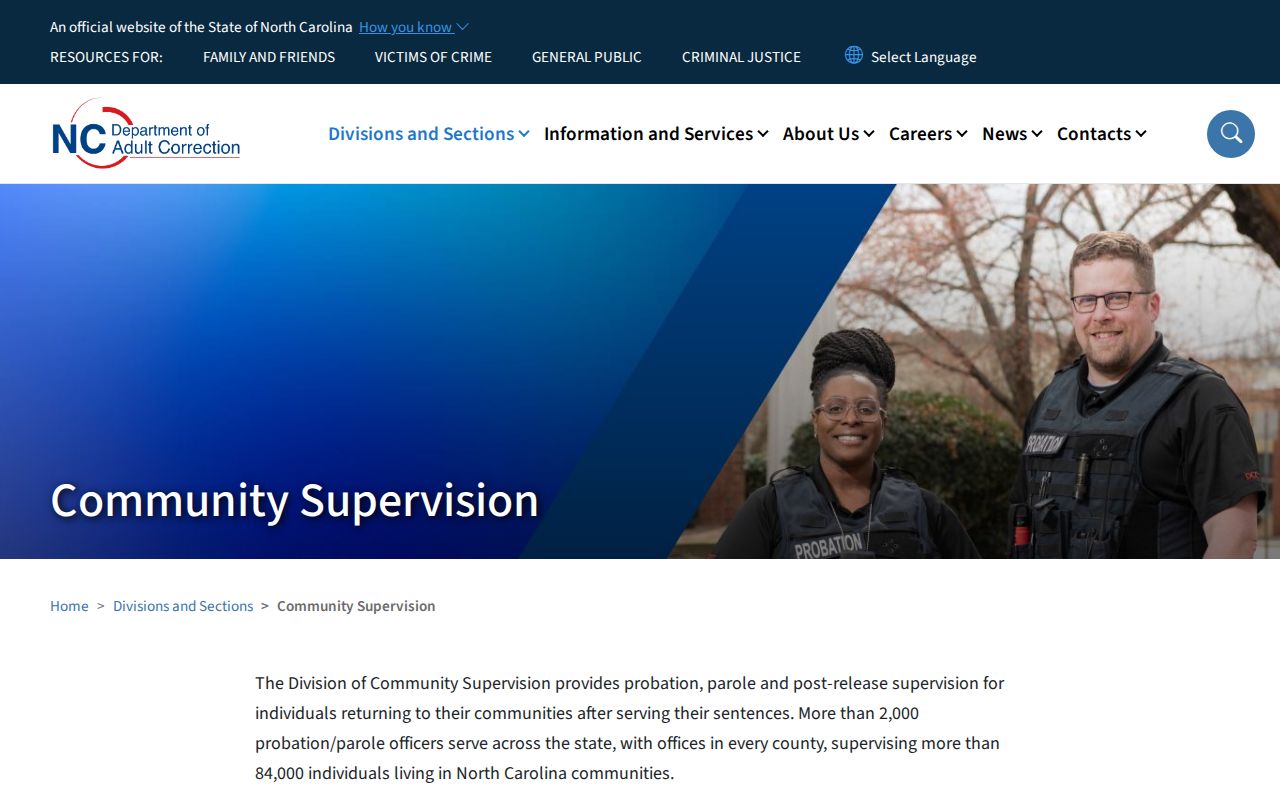
Internal officer notes, treatment records, tests, and violation investigations are not an unrestricted public court history, so use filed motions and orders for the public case record.
Case Record Access & Restrictions
G.S. 7A-109 supports public inspection of clerk-held court records except where another law restricts access. Yet the remote view can be narrower than the record available at the courthouse. Juvenile files, sealed or expunged matters, protected victim and minor details, full dates of birth, account data, and medical or security information can be withheld or redacted. Unreturned process may also be absent.
When a case does not appear, confirm the spelling, aliases, county, and identifier. Then use the courthouse terminal and ask the Clerk whether the file is older, not remotely exposed, restricted, or filed in another county. Returned warrants and other filed process may be public unless sealed, while an active unreturned warrant can remain withheld. Never infer a clean history from one empty screen.
Note: Verify a name match against the case number, charge, dates, and disposition before relying on the Robeson County court record.